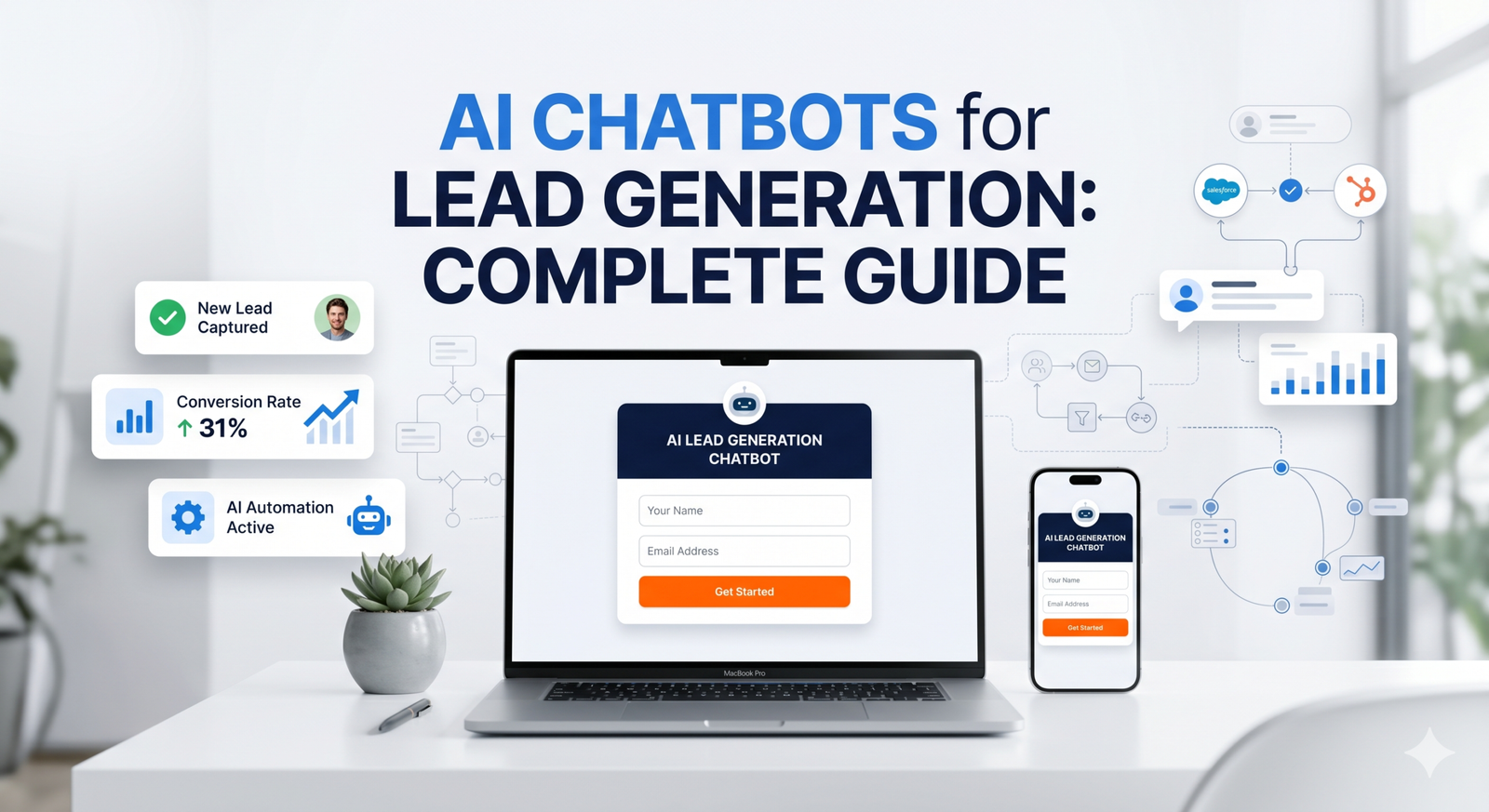
AI chatbots for lead generation are one of the most effective tools a business can deploy in 2026. They work around the clock, engage every visitor the moment they land on your site, collect contact details through natural conversation, and qualify leads automatically before a human ever gets involved. Whether you run a SaaS company, a service business, or an ecommerce store, AI chatbots for lead generation can dramatically increase the number of qualified leads your website produces every single day.
This guide covers everything you need to know about using AI chatbots for lead generation, from how they work and why they outperform static forms, to how to build one and the best practices that separate high-converting bots from ones that get ignored.
If you want to see a working example of an AI lead generation chatbot in action, visit YourSaleMate and start a free agent in under five minutes.
What Are AI Chatbots for Lead Generation?
A lead generation chatbot is a smart software tool that talks to your website visitors like a real person. It asks questions, collects names and emails, and determines whether someone is a good fit for your product or service.
Unlike old-style chatbots that followed fixed scripts with preset button options, today’s AI chatbots for lead generation use large language models to understand what people are actually saying. They hold real conversations, adapt to answers, handle unexpected questions, and feel genuinely human to the visitor on the other end.
Here is the core difference:
- Traditional chatbots follow a fixed decision tree with preset options. Very limited in what they can handle.
- AI-powered chatbots understand natural language, adapt to responses, ask follow-up questions, and manage conversations that go in unexpected directions.
These bots live on your website, landing pages, or social media channels. Their job is to start conversations with visitors and convert them into leads, people who are genuinely interested in what you offer. According to HubSpot’s research on chatbot effectiveness, companies using AI chatbots see measurable improvements in both lead quality and response speed.
How AI Chatbots Generate Leads
Understanding exactly how AI chatbots for lead generation do their job helps you configure them more effectively. Here is a breakdown of each stage.
Website Visitor Engagement
When someone visits your site, the chatbot opens and greets them immediately. It might ask “What brings you here today?” or “Can I help you find what you are looking for?” This kind of proactive engagement keeps visitors on the page longer and gives them a reason to interact instead of bouncing. The chatbot can be triggered by behaviour signals, such as when someone spends 30 seconds on your pricing page. That is a strong buying signal, and the chatbot acts on it in real time.
Lead Capture Through Conversation
Instead of presenting a static form with five fields that feels like homework, the chatbot collects information one question at a time through natural conversation. Name, email, phone number, company size, budget range. The process feels easy and personal, which is exactly why chatbot lead capture significantly outperforms traditional forms. Research consistently shows that conversational lead capture rates are two to three times higher than static form completion rates.
Lead Qualification
Not every visitor is a genuine buyer. The chatbot asks smart qualifying questions to separate high-intent leads from casual browsers. This is called chatbot lead qualification, and it saves your sales team hours of wasted time every week. The bot can assign a lead score based on answers so your team always knows who to prioritise and who needs more nurturing first.
CRM Integration
Once a lead is captured and qualified, the chatbot automatically sends all that data directly into your CRM. No manual entry, no missed leads, no chaos. Everything flows automatically through your chatbot automation workflows, and your sales team wakes up each morning with a clean, organised pipeline.
Lead Nurturing
After the first conversation, the chatbot does not disappear. It follows up with helpful messages, shares relevant content, and keeps leads warm over time. Personalisation makes every follow-up feel relevant rather than generic, which is what separates a chatbot that converts from one that gets ignored.
Benefits of Using AI Chatbots for Lead Generation
Why are so many businesses switching to AI chatbots for lead generation? Because the results are consistent and measurable.
Types of AI Chatbots Used for Lead Generation
Not all chatbots are built the same. Understanding the different types helps you choose the right one for your business.
Rule-Based Chatbots
These follow a fixed decision tree with preset options. Good for very simple and predictable tasks but limited in handling real, open-ended conversations. Most visitors find them frustrating.
AI-Powered Conversational Chatbots
These use large language models and natural language processing to understand context and respond intelligently. Far more effective for lead generation because they handle the unpredictable nature of real human conversations.
Hybrid Chatbots
A combination of rules and AI. They use rules for common repeatable scenarios and switch to AI when conversations become complex or unexpected. A practical middle ground for many businesses.
AI Sales Assistant Chatbots
These are built specifically to qualify and convert leads. An AI sales assistant chatbot can handle common objections, recommend relevant products or services, book demos, and push leads toward a purchase automatically. This is what YourSaleMate is built to do. To understand the full process, see how YourSaleMate works end to end.
Best Ways to Deploy AI Chatbots for Lead Generation
There are several high-impact places to deploy AI chatbots for lead generation. Each serves a different purpose in your funnel.
How to Build an AI Chatbot for Lead Generation
You do not need to be a tech expert to set up an AI chatbot for lead generation. Follow these five steps and you can have a live, trained agent on your website in under 30 minutes.
Define Your Lead Goals
What counts as a lead for your business? An email address? A booked call? A completed form? Be specific before you build anything. The goal shapes every question your chatbot asks and every conversation path it follows.
Choose a Chatbot Platform
Pick a tool that matches your budget and technical ability. Look for one with a no-code builder, CRM integration, conversation analytics, and ideally Calendly integration if meeting booking is part of your sales process. YourSaleMate starts free and covers all of these features out of the box.
Train It on Your Business Content
Upload your website URL, product documents, and custom Q&A pairs. The agent learns everything about your business and gives accurate, relevant answers from day one. Agents trained thoroughly handle 70 to 80 percent of questions automatically without human involvement.
Connect Your CRM and Calendar
Link your chatbot to your CRM so every lead is captured and stored automatically. If your sales process involves booking calls, connect your Calendly account so the chatbot can book meetings directly. Our full guide on chatbot Calendly integration explains this in detail.
Test, Launch, and Optimise
Test the chatbot yourself before launching. Ask it the questions your customers actually ask. Then watch your conversation logs after launch. The data tells you exactly where people drop off, which questions it handles well, and what needs improving. Three rounds of optimisation and most bots hit 80 percent accuracy or better.
Real Examples of AI Chatbots Generating Leads
SaaS Companies
A SaaS business uses an AI chatbot to greet trial sign-up visitors, ask about their goals and team size, and route high-intent leads directly to a sales rep’s calendar. All of this happens in a single conversation without any human involvement.
Service Businesses
A marketing agency uses an AI chatbot for lead generation on their contact page to qualify potential clients, asking about budget, timeline, and goals before a human ever gets involved. The result is that every conversation a sales rep has is already pre-qualified.
E-commerce Stores
An online store uses a chatbot to ask “What are you shopping for today?” and collects the visitor’s email in exchange for a personalised discount code. Simple, fast, and highly effective at building an email list from organic traffic.
B2B Companies
A B2B software company uses an AI sales assistant chatbot to filter out unqualified enquiries and only pass on decision-makers to their sales team. Less time wasted on unqualified leads, more deals closed with the right ones.
Best Practices for AI Chatbot Lead Generation
Follow these principles and your AI chatbot for lead generation will consistently outperform static forms and passive contact pages.
- Ask one question at a time. Never overwhelm visitors with multiple questions at once. A single question feels like a conversation. Multiple questions feel like a form.
- Personalise every response. Use the visitor’s name once you have it. Reference their interests based on the page they landed on. Personalisation increases engagement significantly.
- Use quick reply buttons. For common answers like Yes, No, or specific options, offer tappable buttons. This reduces friction and keeps conversations moving.
- Integrate your CRM from day one. A lead that is not automatically saved is a lead that is eventually lost. Set up CRM integration before you launch.
- Read your conversation logs weekly. The logs are your most valuable source of insight. They show you exactly what visitors are asking, where they drop off, and what converts best.
- Match your brand voice. The chatbot should sound like your brand, not a generic bot. Tone, language, and personality all affect how much visitors trust it.
- Start on high-intent pages. Deploy your AI chatbot for lead generation on your pricing, contact, and demo pages first. These are where buyers are most likely to engage.
Common Mistakes That Kill Chatbot Lead Generation Results
The Future of AI Chatbots in Lead Generation
The technology behind AI chatbots for lead generation is moving fast. Here is what is coming in the next few years.
- AI sales assistants that handle entire sales cycles without human involvement, from first hello to signed contract
- Predictive lead scoring powered by machine learning that knows who is likely to buy before they even ask a question
- Hyper-personalisation where chatbots adapt to each visitor’s behaviour in real time based on what pages they visited and what they clicked
- Voice-enabled chatbots that work through smart speakers and phone calls as well as text chat
- Deeper AI marketing integration connecting chatbots directly with ad platforms, email tools, and social media for fully automated follow-up sequences
Businesses that adopt AI chatbots for lead generation now will have a significant advantage as these capabilities become standard expectations rather than competitive differentiators.
Frequently Asked Questions
AI chatbots for lead generation are no longer an advanced feature reserved for enterprise companies with large budgets. In 2026 they are a standard tool that any business can deploy in under 30 minutes and start seeing results from within the first week. If you are still relying on static forms and hoping visitors fill them out on their own, you are leaving qualified leads on the table every single day.
Start Capturing More Leads on Autopilot Today
YourSaleMate is free to start. Set up your AI chatbot for lead generation in under 5 minutes. No coding, no developer, no credit card required.